DUV 193nm · EUV 13.5nm
See what prints.
Correct what doesn't.
Run DUV/EUV lithography simulations and OPC correction in seconds. No EDA license. No installation. Export publication-ready figures.
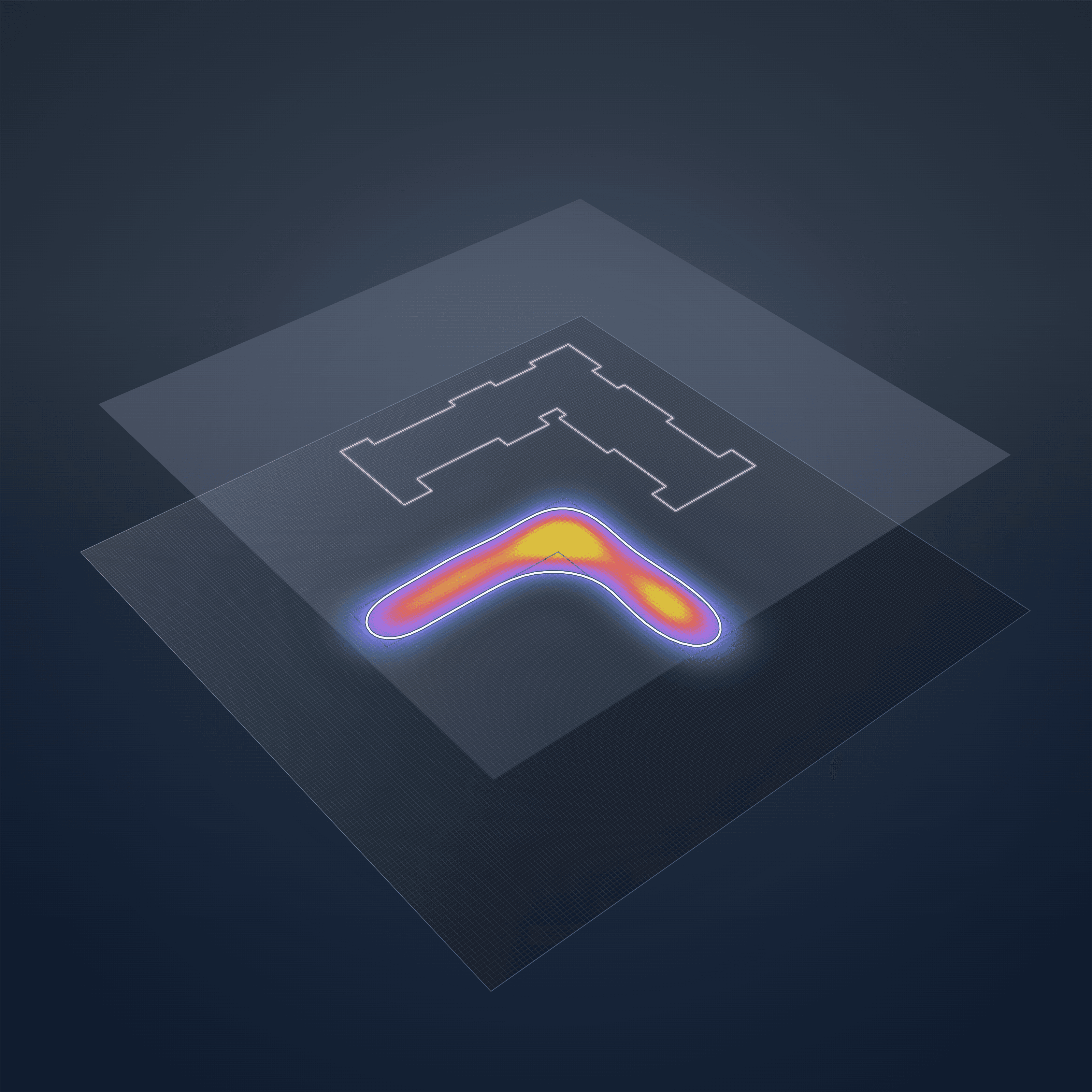
Actual litopc output — mask, aerial image, contour, and 3D silicon view
Hopkins coherent imaging
Export-ready PNG / SVG / CSV
How it works
From mask to silicon — see the physics.
01
Imaging Tool
DUV 193 nm dry ▾
Pattern
L-Shape (DUV) ▾
Set up your simulation
Pick DUV 193 nm or EUV 13.5 nm. Load an L-shape, contact hole, or any built-in template. No install, no EDA license.
02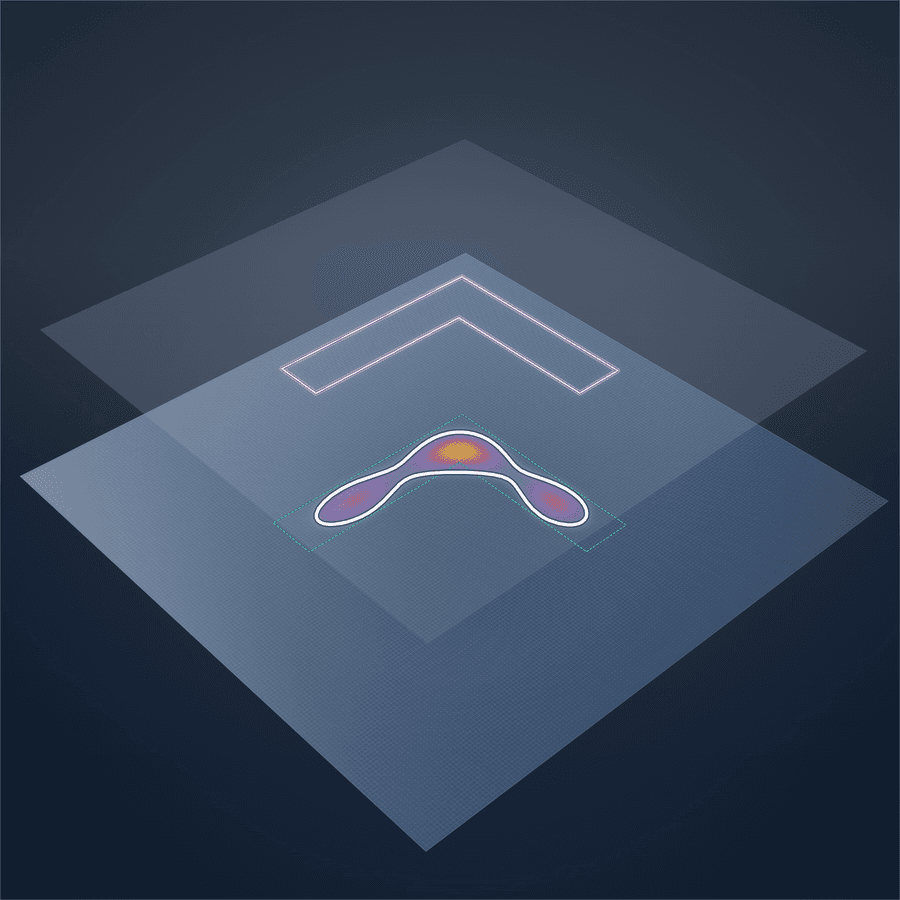
Diffraction distorts the print
193 nm light diffracts through the lens. Corners round, line-ends pull back. The silicon print misses the mask target.
03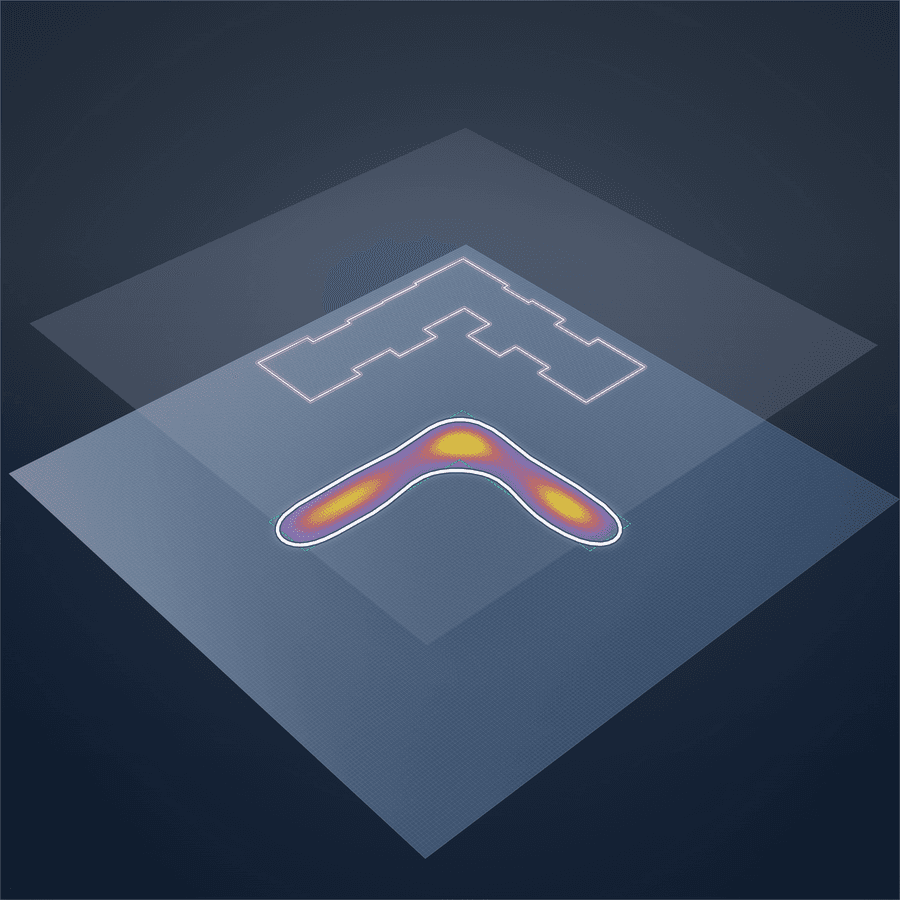
One click — OPC corrects, export
Click Run OPC. Mask vertices shift until EPE converges. Export PNG, SVG, or 3D — auto-captioned for any audience.
The Physics
Wave-optics simulation. Real resolution limits.
Hopkins wave-optics model — the same optical framework used in commercial litho tools, running in your browser. Resolution limits and EPE are physics-derived, not approximated.
Rayleigh Resolution Criterion
CDmin = k1 × λ / NA
k1 ≈ 0.26 – 0.28 · Rayleigh limit · Computed per preset
Edge Placement Error (EPE)
EPE = contouractual − target
Signed distance in nm · Auto-computed per edge segment · Drives OPC iteration
SystemλNALimitTypical
DUV dry193 nm0.93~56 nm~65 nm
DUV immersion Pro193 nm1.35~39 nm~40 nm
EUV Low-NA13.5 nm0.33~11 nm~13 nm
EUV High-NA Pro13.5 nm0.55~7 nm~8 nm
Limit: k1 ≈ 0.27 (Rayleigh) · Typical: production k1 ≈ 0.32 · 1D nested half-pitch · Pro presets require upgrade
Optical presets & templates
Four optical configurations. Eight OPC templates. Ready out of the box.
DUV dryFree
λ193 nm
NA0.93
CDmin~56 nm
DUV immersionPro
λ193 nm
NA1.35
CDmin~39 nm
EUV Low-NAFree
λ13.5 nm
NA0.33
CDmin~11 nm
EUV High-NAPro
λ13.5 nm
NA0.55
CDmin~7 nm
OPC templates included
L-shapeContact holeDense linesIsolated lineLine-endSRAM cellT-junctionCorner rounding
Features
Why litopc
From quick simulation to research-grade process modeling — litopc scales with what you need.
01
1-click OPC correction
Click Run OPC. The algorithm shifts mask vertices until EPE converges at every edge segment. Watch the correction happen iteration by iteration — no scripting, no setup.
02
4 view modes
Mask · aerial image · printed contour · 3D silicon surface — all in one workspace. Switch views instantly. A/B compare any two parameter sets side by side.
03
Batch sweepPro
Sweep focus, dose, sigma, or any parameter across up to 120 points (Pro) or 200 points (Research). Results shown as an overlay grid — Bossung curves auto-generated.
More features ↓
04
8 color maps & export
Hot, Viridis, Plasma, Grayscale, Inferno, and more. Adjust the intensity scale. Export PNG up to 4200 px or SVG — every figure auto-includes λ, NA, k₁, and CD_min captions.
05
EPE & CD per edge
Edge placement error computed at every contour segment. CD measured across critical dimensions. Both auto-updated on every run — no manual measurement needed.
06
Custom process modelResearch
Dial in Mack resist parameters (n, m, Eth), set isotropic etch bias, and run Focus-Exposure Matrix sweeps. Process window analysis without an EDA stack.
Who it's for
Built for anyone who works with light and silicon.
Students & Researchers
Understand OPC intuitively — no EDA license required. Visualize how k₁ factor limits resolution at different NA values. Generate thesis and paper figures in minutes.
Process & Design Engineers
Quick sanity checks before running full Calibre or Synopsys flows. Generate clear lithography figures for design reviews, tape-out presentations, and internal reports.
Educators
Show students real aerial images, not textbook diagrams. Use litopc in lecture slides to make lithography physics tangible and interactive.
Research Teams & Startups
Custom process models, etch bias parameters, and Bossung curves — without a six-figure EDA license. Ideal for academic process labs, equipment R&D, and semiconductor startups exploring new nodes.
Pricing
Start free. Upgrade when you need more.
Every plan includes the full physics engine. Pro unlocks advanced optics and batch analysis. Research adds custom process model integration.
Beta period — no subscription fee. Free plan is open to everyone. Pro is in closed beta testing; paid billing is not yet active.
Free
$0/mo
Everything you need to explore OPC and lithography basics.
- ✓DUV 193 nm dry (NA 0.93)
- ✓EUV 13.5 nm Low-NA (NA 0.33)
- ✓All OPC templates
- ✓Manual mask editor (up to 5 shapes)
- ✓2D aerial & contour view
- ✓HD export (up to 1800 px)
- ✓8 saved scenarios
- ✓20 simulation runs / day
Closed Beta
Pro
$19/mo
or $149/yr save $79
Advanced optics, higher resolution, and batch sweep for serious work.
- ✓Everything in Free
- ✓DUV 193 nm immersion (NA 1.35)
- ✓EUV High-NA (NA 0.55)
- ✓Manual mask editor (up to 48 shapes)
- ✓3D silicon surface view
- ✓Batch parameter sweep (120 pts)
- ✓High-res export (up to 4200 px)
- ✓Unlimited saved scenarios
- ✓2,000 simulation runs / day
- ✓No ads
Research
Research
$79/mo
or $699/yr save $249
Custom process models, Bossung curves, and process window analysis for fab-grade insight.
- ✓Everything in Pro
- ✓Custom resist model (Mack: n, m, Eth)
- ✓Etch bias correction (isotropic)
- ✓Focus-Exposure Matrix / Bossung curves
- ✓Process window analysis
- ✓Custom illumination shape (annular, dipole)
- ✓Batch sweep up to 200 points
- ✓10,000 simulation runs / day
- ✓Priority simulation queue
- ✓PDF process report export
For team or institutional licensing, contact us. Calibre costs $100k+/year — litopc is not a sign-off replacement, but it should cost a lot less.
About
Built by a working OPC engineer.
Min-Cheol Lee — OPC and lithography engineer at Intel. Ph.D. in Physics, with research background spanning optical and condensed matter physics. Specialized in semiconductor patterning simulation and OPC for advanced nodes.
Ready to simulate?
Free to use. No sign-up required to start.